OpenCodeReview: Alibaba’s AI Code Review Tool That Catches Real Bugs
OpenCodeReview is Alibaba’s open-source AI code review tool, released in May 2026 and already trusted by tens of thousands of developers inside Alibaba. It combines deterministic engineering pipelines with an LLM agent to catch real bugs — null pointer exceptions, thread-safety issues, XSS and SQL injection — with precise line-level comments, using about one-ninth of the tokens of a general-purpose agent.

Key facts
- Project: OpenCodeReview (alibaba/open-code-review)
- Stars: 52,514
- Forks: 4,217
- Licence: Apache-2.0
- Created: 18 May 2026
- Commits: 863
- Releases: 148
- GitHub Trending: #6 on 16 November 2026
What Is OpenCodeReview and Why Does It Matter?
OpenCodeReview is a hybrid-architecture code review tool that started life as Alibaba Group’s internal, official AI code review assistant. For more than two years it served tens of thousands of developers across Alibaba, and in that time it identified millions of code defects before they reached production. In May 2026, Alibaba open-sourced it, and the community responded fast: the project has already collected more than 52,000 stars and 4,000 forks, and it reached number six on GitHub Trending on 16 November 2026.
At KongoTech, we track the open-source tools that genuinely change how developers work, and OpenCodeReview stands out because it was battle-tested at Alibaba’s scale before it was ever released to the world.
What’s Wrong with General-Purpose AI Agents for Code Review?
General-purpose coding agents such as Claude Code are impressive, but code review is a specialised job, and generalists are not always the best specialists. When you ask a general-purpose agent to review a pull request, it reads the whole diff, reasons from scratch about every file, and produces a long list of comments. Many of those comments are vague, some are wrong, and the important findings get buried in the noise. Developers soon learn to skim or ignore the output, which defeats the purpose of the review entirely.
The second problem is cost. A general-purpose agent burns through a large number of tokens on every review because it re-reads and re-reasons about code it has already seen. On a busy repository with dozens of pull requests a day, that token bill adds up quickly, and the review itself is slower than it needs to be.
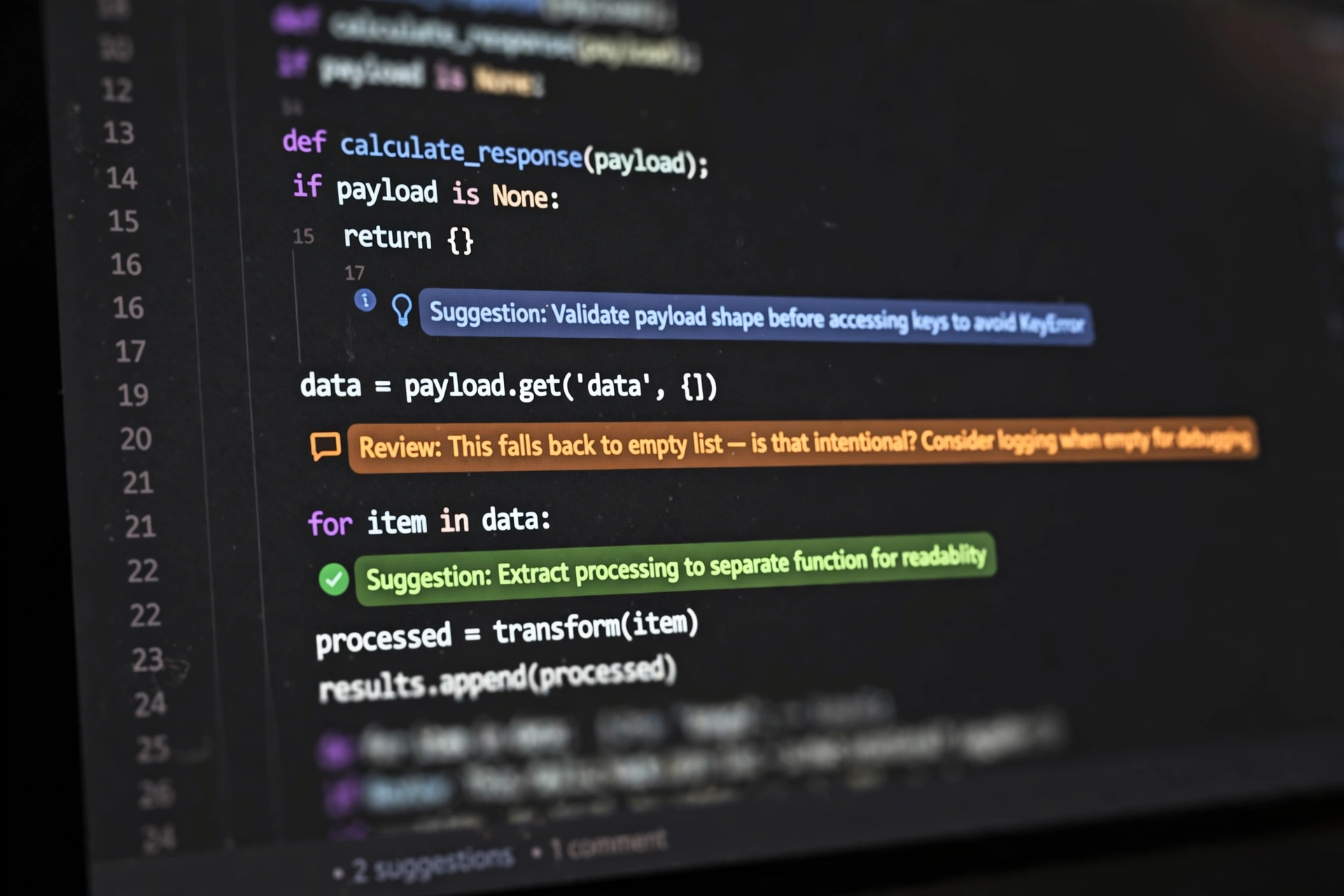
The third problem is precision. A useful code review comment must point to the exact line, explain the exact defect, and suggest a concrete fix. General-purpose agents often comment at the level of a whole file or function, leaving the developer to hunt for the problem. OpenCodeReview was built to solve all three of these problems at once: less noise, far fewer tokens, and comments pinned to the exact line.
How Does the Deterministic + Agent Hybrid Design Work?
OpenCodeReview’s core design is a hybrid of two approaches: deterministic engineering and an LLM agent. Most AI tools pick one or the other. OpenCodeReview uses both, and the combination is what makes it accurate.
The deterministic side does the heavy lifting before the language model ever sees the code. Precise file selection picks out exactly which files changed and are worth reviewing. Smart file bundling groups related files together, so the model reviews a coherent unit of change. Fine-grained rule matching runs the built-in multi-language ruleset — covering null pointer exceptions, thread-safety issues, XSS and SQL injection — against the changed code. Positioning and reflection modules then check that each finding is attached to the correct line before it is shown to the developer.
The agent side adds the judgement that rules alone cannot provide. An LLM agent, guided by scenario-tuned prompts and a dedicated toolset, reads the Git diff, sends the changed files to a configurable language model, and generates structured review comments with line-level precision. Because the deterministic pipeline has already narrowed the work down, the agent focuses on the parts where human-like reasoning actually helps — understanding intent, spotting logic errors, and judging whether a flagged issue is a real bug or a false alarm.
This division of labour is the key insight. Deterministic pipelines are fast, cheap and repeatable; agents are flexible and smart. OpenCodeReview lets each side do what it does best, and the result is a review that is both more accurate and far cheaper than asking a general-purpose agent to do everything. It sits naturally alongside other AI developer tools, from office-focused AI like Univer to the agent frameworks reshaping how software gets built.
How Good Are the Benchmark Results?
Claims about AI tools are easy to make, so the OpenCodeReview team built a serious benchmark to back theirs up — and the numbers are striking. The benchmark was constructed from 50 popular open-source repositories, 200 real pull requests and 10 programming languages, and it was cross-validated by more than 80 senior engineers who annotated 1,505 ground-truth issues — a real, human-checked dataset.
Against general-purpose agents such as Claude Code, using the same model, OpenCodeReview achieved significantly higher Precision and F1 scores: a larger share of its comments point to real bugs, and it balances catching defects with avoiding false alarms. It did so with roughly one-ninth of the tokens and in less time — a review a team can afford to run on every pull request.
There is one honest trade-off in the results: Recall is lower by design. OpenCodeReview deliberately favours precision over noise, which means it may miss a few real issues in exchange for not flooding developers with false positives. That is a deliberate choice, and a sensible one. In practice, a review tool that cries wolf too often gets ignored, while a tool that only speaks when it is confident gets read.

How Do You Install OpenCodeReview and Run Your First Review?
Getting started with OpenCodeReview takes only a few minutes. The tool is distributed as an npm package, and the only prerequisite is Git 2.41 or newer. Install it globally with a single command:
npm install -g @alibaba-group/open-code-reviewOnce installed, the ocr command is available in your terminal. The first step is to tell it which language model provider and model to use:
ocr config provider
ocr config model
The tool is compatible with OpenAI and Anthropic models, and the configuration is flexible enough to point at other compatible providers too. To review your current changes, run:
ocr reviewThat reviews the uncommitted changes in your working directory. For a branch comparison, specify the range explicitly:
ocr review --from main --to feature-branchTo review a specific commit, pass its hash:
ocr review --commit abc123If you want a full review of an entire file rather than just the changed lines, use the scan command:
ocr scanThis reads whole files, useful for a deeper check of a critical module. You can also keep track of past reviews with the session command:
ocr session listThe whole workflow is designed to fit naturally into a developer’s day: install once, configure once, then run a single command whenever you want a second pair of eyes on your code.
What Is Delegation Mode?
Delegation mode is one of OpenCodeReview’s most interesting features, and it solves a practical problem: what if you want OpenCodeReview’s review quality but you are already working inside another AI coding assistant? Delegation mode lets the host agent run the review using its own model, with no OCR API key needed.
The command is straightforward:
ocr delegate previewIn this mode, OpenCodeReview hands its deterministic pipeline — the file selection, bundling, rule matching and positioning — to the host agent, which then performs the review with the model it already has. The result is the same precise, line-level feedback, but without any extra API configuration or cost. It works with Claude Code, Codex, Cursor, Kimi Code, OpenCode and QCA Forward, which covers most of the AI coding assistants developers actually use today.
This approach reflects a wider shift in AI tooling, where tools increasingly talk to each other through shared standards rather than living in isolation. Agent interaction standards such as AG-UI are pushing the same idea forward: agents that cooperate instead of competing.

How Do You Use OpenCodeReview in CI/CD?
OpenCodeReview is not only a command-line tool for individual developers. It is built to run in continuous integration and continuous delivery pipelines, so that every pull request gets reviewed automatically, before a human reviewer even opens it. The project supports GitHub Actions, GitLab CI, GitFlic CI and Gerrit, which covers the platforms most teams use.
Typically, the pipeline triggers OpenCodeReview on every new pull request. The tool reviews the diff, posts its line-level comments directly on the pull request, and the human reviewer starts from a reviewed diff instead of a blank one. Obvious bugs — a null dereference, a SQL injection risk, a race condition — are already flagged, so the human reviewer can spend their time on design, architecture and intent, the things only a person can judge.
Because the tool uses roughly a ninth of the tokens of a general-purpose agent, running it on every pull request is affordable even for busy repositories. Automatic review on every pull request raises the quality floor of the whole codebase, catches defects while they are still cheap to fix, and gives junior developers instant, specific feedback on their code.
Frequently Asked Questions
Is OpenCodeReview free to use?
Yes. OpenCodeReview is open source under the Apache-2.0 licence, so it is free to use, modify and distribute, including in commercial projects. You only pay for the language model calls you make, and because the tool uses roughly one-ninth of the tokens of a general-purpose agent, those costs stay low.
Which programming languages does OpenCodeReview support?
The benchmark covers 10 programming languages, and the built-in ruleset is multi-language, covering null pointer exceptions, thread-safety issues, XSS and SQL injection. The tool reads Git diffs, so it works with any language stored in a Git repository.
Does OpenCodeReview replace human code reviewers?
No. OpenCodeReview handles the mechanical, repeatable part of review — finding concrete defects and pointing at the exact line. Human reviewers are still essential for judging design, architecture, naming and intent. The tool makes human review faster and better by clearing away the obvious bugs first.
How is OpenCodeReview different from asking Claude Code to review my code?
The main differences are precision, cost and speed. OpenCodeReview combines deterministic pipelines with an LLM agent, giving it significantly higher Precision and F1 scores than a general-purpose agent using the same model, while using about one-ninth of the tokens and running faster. Its comments are pinned to exact lines rather than whole files or functions.
Can I use OpenCodeReview without an API key?
Yes, through delegation mode. Running ocr delegate preview lets your host agent — such as Claude Code, Codex, Cursor, Kimi Code, OpenCode or QCA Forward — run the review with its own model, so no separate OCR API key is needed.
Conclusion
OpenCodeReview is one of the most impressive open-source AI tools of 2026, and the numbers explain why. Born inside Alibaba, tested for over two years by tens of thousands of developers, and proven against a benchmark of 200 real pull requests validated by more than 80 senior engineers, it catches real bugs with higher precision than general-purpose agents while using about a ninth of the tokens. The hybrid design — deterministic pipelines doing the precise, repeatable work and an LLM agent adding judgement — is a model other AI tools would do well to copy.
For individual developers, it is a one-command install that adds a tireless reviewer to every change. For teams, its CI/CD support means every pull request is reviewed automatically. And with delegation mode, it fits into whatever AI assistant you already use. As the ecosystem of agent tools and skills keeps growing — from frameworks to agent skills like Stitch Skills — OpenCodeReview shows what happens when a tool is built for one job and built to do it well.