Last30Days Skill: Research Any Topic Across Reddit, X, YouTube and the Web With an AI Agent
Last30Days Skill is an AI agent skill that researches any topic across Reddit, X, YouTube, TikTok, Hacker News, Polymarket, GitHub and the wider web, then synthesizes the findings into one grounded summary scored by what real people actually engaged with. You run one command, and your coding agent does the searching, the scoring and the writing.

Key facts
- Project: mvanhorn/last30days-skill on GitHub — an AI agent-led search engine that searches people, not editors
- GitHub stars: 69,469, with 6,181 forks (checked 18 November 2026)
- Licence: MIT License
- Created: 23 January 2026
- Commits: 1,565, across 83 releases
- GitHub Trending: repository of the day badge, and one of the fastest-growing research skills of 2026
- Works with: Claude Code, Codex, Cursor, Copilot, Gemini CLI, OpenClaw, Grok and 50+ Agent Skills hosts
- Sources searched: Reddit, X, YouTube, TikTok, Instagram, Hacker News, Polymarket, GitHub, Digg, arXiv, Techmeme, LinkedIn, Bluesky and more
What Is the Last30Days Skill and Why Does It Matter?
The Last30Days Skill answers a question every researcher, founder and developer asks daily: what actually happened in the last thirty days? Search engines give you pages ranked by editors and search optimisation. Social platforms each hold one piece of the truth behind their own login wall. Last30Days bridges them. You ask your agent about a person, a company or a topic, and it searches Reddit threads, X posts, YouTube transcripts, TikTok clips, Hacker News discussions, Polymarket odds and the open web in parallel, then an AI agent judge synthesizes everything into one brief.
The scoring is the idea that makes it different. A Reddit thread with 1,500 upvotes counts for more than a blog post nobody read. A TikTok watched by 3.6 million people says more about what is culturally relevant than a press release. Polymarket odds backed by 66,000 dollars in volume are harder to argue with than a pundit’s guess. The project puts it plainly: Google aggregates editors, while Last30Days searches people. The synthesis ranks by social relevancy, not search-engine relevancy, so the brief reflects what real people engaged with, argued about and bet on.
The numbers back up the interest. The project was created in January 2026 and passed 69,000 stars by mid-November 2026, with more than 6,000 forks and 83 releases. The skill’s author built it to keep up with AI, then found it worked just as well before a sales call, before a meeting, or before building anything new. New research tools like this one appear regularly on the KongoTech homepage, where each week’s trending developer projects get the same close treatment.
How Does Last30Days Score Its Sources?
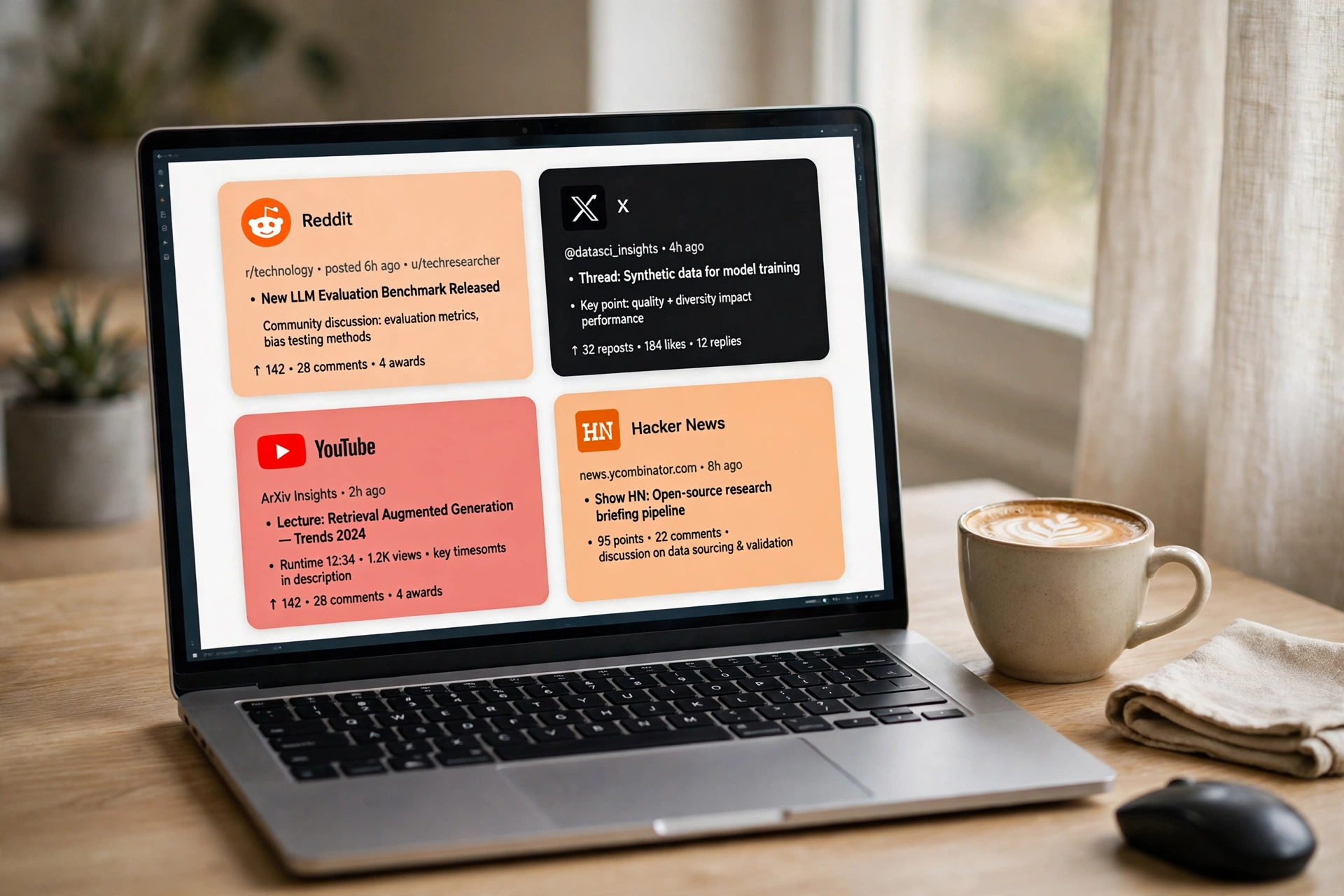
Every source in a Last30Days brief carries the signal of the people who used it. Reddit contributes the unfiltered take: top comments with real upvote counts, free, with no API key needed. X brings the hot take, the expert thread and the breaking reaction, first to know and first to argue. YouTube supplies the long deep dive, with full transcripts searched for the five quotable sentences that matter. TikTok and Instagram Reels add the creator and influencer perspective, including spoken-word transcripts. Hacker News adds the developer consensus, the place where technical people actually argue.
Polymarket is the most unusual source, and the most honest one. It does not record opinions; it records odds backed by real money. The report puts a market’s odds on one line under the story they bear on, with how much they moved. A market at 96 percent confidence on album sales, or 4 percent on an acquisition, is a number you can argue with far less than a headline. GitHub adds its own signal for people and topics: pull-request velocity, top repositories by stars and release notes for a person, issues and discussions for a topic. What Is Univer shows an agent working inside a live office document, and Last30Days applies the same agent-first thinking to research: the agent goes and reads the sources, instead of handing you a list of links to read yourself.
How Do You Install the Last30Days Skill?
Installation takes about a minute, and the recommended route depends on your agent. In Claude Code, the skill installs through the plugin marketplace with two commands:
/plugin marketplace add mvanhorn/last30days-skill

/plugin install last30days
That route auto-updates through the marketplace. For Codex, Cursor, Copilot, Gemini CLI or any of the 50-plus Agent Skills hosts, the command is:
npx skills add mvanhorn/last30days-skill -gThe -g flag installs it globally for your user, so it is available across all projects; drop it to scope the install to one project. There are also routes for Grok through the xAI Build CLI, for claude.ai on the web, for Claude Desktop, for OpenClaw, and a manual developer install. The runtime skill specification lives in the skills/last30days/SKILL.md file inside the repository, which the project describes as the source of truth for the latest command and setup behaviour.
The setup is deliberately close to zero-config. Reddit, Hacker News, Polymarket and GitHub work immediately, and so do patent filings and careers pages when your topic is a company. Run the skill once and a setup wizard unlocks X, YouTube, TikTok, arXiv, Techmeme and more in about thirty seconds. You bring your own keys and browser sessions for the platforms that need them, which is the whole unlock: no single AI has access to all of these platforms natively, because each one is a walled garden with its own API, tokens and authentication.
What Can You Actually Use Last30Days For?
The most common use is before a meeting. The project’s own example is striking: run the skill on a person you are meeting tomorrow, and instead of a LinkedIn profile from 2023 you get what they are actually doing this month. In the example, the brief found that the person had joined OpenAI to work on Codex, had shipped 23 pull requests at an 85 percent merge rate, and was building a cross-device agent control project, while a Reddit community debated the same person with 569 upvotes. That material was scattered across X posts, Reddit threads, YouTube transcripts and GitHub commits, and none of it was on Google.
The second use is company research, and here the skill has two tricks no search engine offers. Jobs Page Secret Signals read a company’s own careers page and flag roles that hint at something unannounced: a director role testing whether requests trigger transactions through partner APIs, for example, which reads like quality control for an assistant that completes purchases. Patent Secret Signals do the same with new US patent filings, flagging applications that are out of character for the company or describe something it has not shipped.
The third use is discovery. Ask the skill what is exploding in AI agents, and it switches to discovery mode: the engine sweeps Reddit category listings, Hacker News front and best stories, Digg stories and X when authenticated, your agent judges the nominations, filters the junk, and writes podcast or article angles. You get five to ten velocity-ranked topics, each with cross-source numbers and a momentum label.
What About Privacy, Keys and Your Data?
Last30Days runs inside your own agent, and the data handling follows from that shape. The skill searches platforms using your own keys and your own browser sessions, so the credentials stay yours. Reddit can optionally be searched as your own logged-in account for more threads and live scores, and only with your approval. Your local files are searched only when you opt in with a corpus flag or a configuration variable, and only from the directories you name.
Two honest limits belong here. First, the quality of a brief depends on the keys you bring: without X or YouTube credentials, those sources stay out of the report, and the skill is upfront about which sources need what. Second, the skill is a research assistant, not a fact-checker: it synthesizes what people said and how strongly they engaged with it, so a confident-sounding brief can still repeat a popular misconception. Treat the cited sources as the evidence and the summary as the starting point, especially before a decision that costs money. AG-UI covers the protocol side of agent-to-user interaction, and Last30Days shows why that interaction matters: the agent shows its sources, you judge them, the agent refines.

Who Should Use the Last30Days Skill?
The skill fits anyone whose work depends on knowing what changed recently. Founders researching a competitor, salespeople preparing for a call, journalists checking a story, developers tracking a fast-moving field, and investors reading a company all get the same benefit: a grounded brief in minutes instead of an afternoon of tab-hopping.
It fits teams, too. A team that runs the same research every week can share the skill and its configuration, and the briefs become comparable over time: the same topic, the same sources, the same scoring, thirty days apart. Stitch Skills for Google Stitch shows the same instinct in another tool: package a proven way of working once, reuse it many times. Who should skip it? If your research questions are evergreen and change slowly, a normal search engine and a good bookmark folder are enough. For everyone tracking something that moves weekly, the test is quick: install the skill, run it on one person or company you care about, and compare the brief with what Google gave you.

Frequently Asked Questions
What is the Last30Days Skill?
The Last30Days Skill is an AI agent skill that researches any topic across Reddit, X, YouTube, TikTok, Hacker News, Polymarket, GitHub and the web, then synthesizes the findings into one grounded summary scored by real engagement.
Which AI agents work with Last30Days?
It works with Claude Code, Codex, Cursor, Copilot, Gemini CLI, OpenClaw, Grok and more than 50 Agent Skills hosts, plus claude.ai on the web and Claude Desktop.
How do I install the Last30Days Skill?
In Claude Code, run /plugin marketplace add mvanhorn/last30days-skill followed by /plugin install last30days. For other Agent Skills hosts, run npx skills add mvanhorn/last30days-skill -g.
Does Last30Days need API keys?
Reddit, Hacker News, Polymarket and GitHub work with no configuration. A first-run setup wizard unlocks X, YouTube, TikTok, arXiv and Techmeme in about thirty seconds using your own keys and browser sessions.
Can Last30Days find trends before they peak?
Yes. Ask it what is exploding in a field and it switches to discovery mode, sweeping Reddit, Hacker News, Digg and X, then returning five to ten velocity-ranked topics with cross-source numbers and a momentum label.
Conclusion
Last30Days Skill is a small idea with a large effect: it treats the attention of real people as the ranking signal for research. With 69,469 stars, 6,181 forks and a place at the top of GitHub Trending, it is clearly solving a problem researchers feel every day. Search engines aggregate editors; this skill searches people, scores what they engaged with, and hands you one brief you can act on.